 Lavare Journal
You will banish sour odors from cotton dishcloths using controlled boiling and mild alkaline baths. Learn how grease buildup hosts biofilm and discover straightforward ways to boil it clean.

- Bacterial biofilm thrives inside fat deposits trapped between twisted cotton fibers.
- Boiling with washing soda breaks down stubborn lipid films that cold cycles miss.
- Complete line drying stops anaerobic bacterial regrowth before cloths are stored.
In our kitchens, washcloths bear the brunt of everyday work. We use them to wipe warm cast-iron skillets, gather breadcrumbs from rough-sawn oak counters, absorb stray drops of olive oil, and dry our hands between peeling vegetables and chopping herbs. Whether we favor heavy unbleached cotton waffle, rough-textured linen-hemp canvas, or everyday loop-back terry, these small squares of fabric are durable tools. Yet, after weeks of steady service, almost every kitchen cloth develops a distinct, stubborn stale quality. It begins as a faint vinegar tang when wet and deepens into a sharp, sour funk the moment warm water hits the weave.
This persistent damp smell is not a sign that the cloth has reached the end of its working life, nor is it an excuse to discard natural fibers in favor of synthetic microfiber wipes. Instead, it is an indicator of an interrupted cleaning cycle. Traditional domestic textile maintenance understood that vegetable oils, animal fats, and bacterial colonies weave themselves deep into the hollow cores of natural plant fibers. In this guide, we walk through the exact material processes needed to strip these residues out: from the chemistry of greasy residues to stove-top boiling with mineral salts, deliberate rinsing, and the restorative power of open air.
What Causes the Characteristic Sour Dishcloth Odor
The sour smell that arises from a used dishcloth is caused by a mixture of microbial colonization and decaying lipids. When we wipe a kitchen board or a dinner plate, our cloths collect microscopic food particles: proteins from milk, starches from pasta water, and microscopic droplets of fat. These organic compounds sink into the tiny hollow channels within cotton and linen fibers, known botanically as the lumen. In this warm, humid microclimate, ambient bacteria such as Moraxella osloensis and various common micrococci multiply rapidly.
These bacteria do not merely sit on the surface of the cloth. They produce a sticky extracellular polysaccharide matrix, commonly called a biofilm. This matrix glues the microorganisms directly to the cellulose threads, shielding them from quick surface rinses under the tap. As the bacteria consume the trapped proteins and fats, they emit metabolic byproducts. These volatile organic compounds include butyric acid, which smells of rancid butter, and isovaleric acid, which carries the sharp aroma of stale sweat and aged cheese.
Compounding this microbial activity is the oxidative rancidity of plant oils. When cooking oils such as canola, olive, or sesame sit spread across thousands of square millimeters of exposed fiber surface, they oxidize on contact with the air. Over several days, these drying oils cross-link, harden slightly, and turn rancid. The resulting aroma is heavy, stale, and metallic. When bacterial off-gassing and rancid oil molecules combine inside the interior of a damp kitchen cloth, normal warm water from the sink faucet is simply incapable of loosening the hold.
Why Cold Washing Fails Against Kitchen Grease
Modern laundry advice often advocates for cold water cycles to save energy and protect delicate dyes. While a 20-degree or 30-degree Celsius wash works adequately for lightly worn clothing made from synthetic blends, it fails kitchen work linens. The fundamental obstacle is the physical melting point of culinary lipids. Animal fats and saturated plant shortenings solidify at room temperature, while unsaturated fats turn thick and gummy inside the dense twists of spun cotton yarn.
When exposed to cold water, fats do not dissolve. Instead, they harden, cementing dust, bacteria, and starch granules deep inside the interior cavities of the yarn. Conventional liquid detergents contain surfactants designed to surround oil droplets, but these surfactants cannot easily penetrate a solidified film of grease without sufficient thermal energy. The mechanical agitation of a domestic washing machine drum merely pushes the cold water through the exterior weave, leaving the greasy bacterial core completely intact.
| Fat or Lipid Type | Melting Range | Reaction to Cold Tap Water (15-20 C) | Reaction to Hot Alkaline Bath (90 C) |
|---|---|---|---|
| Cultured Butter | 32 to 35 C | Solidifies into greasy paste around yarns | Melts and saponifies rapidly into water-soluble soap |
| Rendered Lard / Tallow | 38 to 48 C | Crystallizes into hard, water-repellent wax | Liquefies completely, broken down by alkali |
| Extra Virgin Olive Oil | Minus 6 to 6 C | Remains liquid but clings stubbornly to cellulose | Emulsifies readily with sodium carbonate |
| Bacon Grease | 30 to 33 C | Forms an insoluble, odorous film across fibers | Dissolves; release of bound food proteins occurs |
As shown in the table above, standard tap water temperatures cannot reach the threshold required to render these fats fluid. Furthermore, cold washing allows detergent residues to build up over time. Many commercial detergents contain synthetic fragrances and brightening agents that coat the yarn rather than clean it. In cold water, these coatings bond with the unrendered kitchen fats, creating an invisible, water-resistant shield that locks sour odors into the weave indefinitely.
Setting Up a Stove Boil with Sodium Carbonate
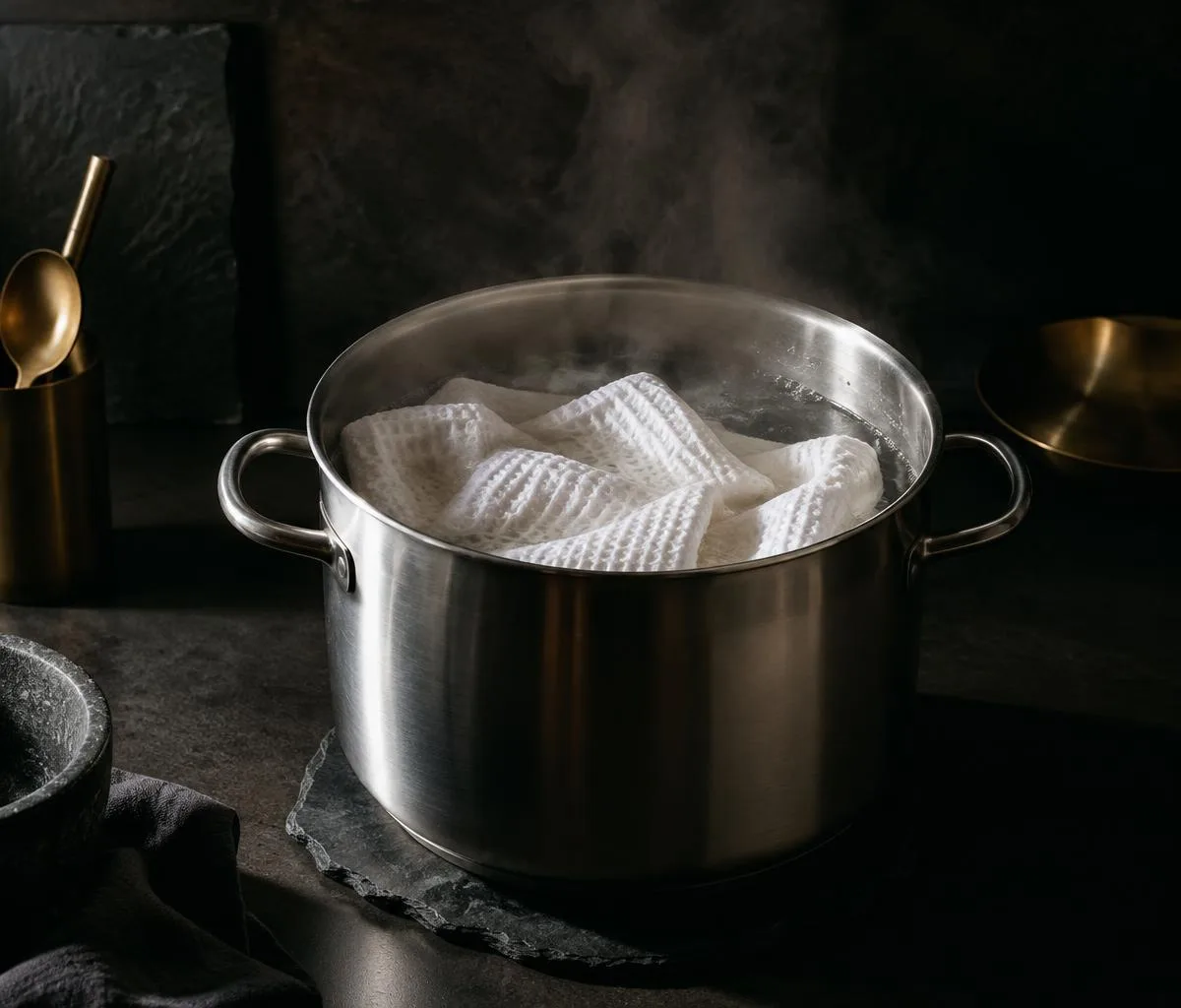
To truly clear these compacted residues, we return to the historic domestic method of boiling washcloths on the stove. This process relies on thermal breakdown and alkaline saponification. Saponification is the chemical reaction where a strong alkali converts fatty acids and triglycerides into soluble soap salts. For this task, we turn to sodium carbonate, commonly sold as washing soda or soda ash. Sodium carbonate creates a wash bath with a pH between 11 and 11.5, which is significantly more effective at breaking grease bonds than gentle sodium bicarbonate (baking soda), which typically plateaus at a mild pH around 8.3.
Before beginning, select the right vessel. We use a deep, wide pot made of non-reactive stainless steel or unchipped enameled cast iron. Never use raw aluminum cookware for this process; the high alkalinity of the sodium carbonate reacts aggressively with aluminum, pitting the metal and turning the pot and your fabrics an unrecoverable dull gray. Ensure the pot has ample room for the cloths to move freely in the liquid without crowding.
Prepare the boiling bath using these deliberate steps:
- Measure the water volume: Pour 4 to 5 liters of cold, clean water into the pot. This volume gives four to six medium dishcloths enough room to circulate without catching against the bottom.
- Dissolve the washing soda: Add 2 to 3 level tablespoons of pure sodium carbonate powder directly into the cold water. Stir with a long-handled wooden spoon or stainless steel paddle until the crystals dissolve entirely and the water looks clear.
- Submerge the textiles: Place the dry or lightly dampened cloths into the pot one by one. Press them down into the liquid until they are thoroughly saturated and no pockets of trapped air keep them buoyant.
- Apply gradual heat: Set the pot over medium heat on your stove burner. Bring the liquid up to a bare simmer, aiming for roughly 90 to 95 degrees Celsius. Avoid a wild, rolling boil, which can snap the finer warp threads of older cloths through violent churning.
- Simmer and stir: Maintain this quiet, steaming simmer for 20 to 30 minutes. Every five minutes, use your spoon to turn the cloths over, drawing the ones at the bottom up to the surface so the heat and alkaline water reach every seam, hem, and corner evenly.
As the bath simmers, you will notice the water turning a pale, murky amber or grayish yellow. This discoloration is visual proof of the process at work: the alkaline water is pulling out embedded oils, old detergent surfactants, and oxidized food coloring, while the prolonged heat breaks down the bacterial biofilm walls.
Mechanical Wringing and Thorough Water Rinses
Once the simmering time has passed, turn off the burner. The water will be laden with saponified fats, suspended dirt, and alkaline salts. If you leave the cloths to cool down inside this bath, the fibers will simply reabsorb the suspended grime as the temperature drops. The extraction phase requires immediate, careful mechanical work while protecting your hands from scalds.
Using wooden laundry tongs or clean kitchen tongs, lift each cloth out of the hot pot and drop it into a clean sink or a wide enamel basin. At this point, the fibers are swollen with heat and softened by the alkaline bath. Run warm tap water over the cloths to begin diluting the heavy alkaline liquor without causing thermal shock to delicate linen weaves. Gradually reduce the tap temperature from warm down to tepid as you work.
The method of wringing matters deeply to the longevity of the fabric. Avoid twisting the cloth violently into a tight, strained spiral; this action shears the horizontal weft yarns against the vertical warp yarns and stretches the edge binding out of square. Instead, adopt the traditional press-and-fold method:
- First wash-down: Rinse each cloth individually under flowing water until the run-off loses its slippery, soapy feel.
- The flat accordion fold: Lay the damp cloth flat on the bottom of the basin and fold it into neat thirds, then into thirds again, creating a small, tidy rectangle.
- The palm press: Press the folded pad firmly between the palms of your hands or push down hard against the flat slope of the sink basin. This forces out the dirty liquor without torturing the yarn structure.
- The neutralizing bath: Fill your basin with cool, clean water and add 2 tablespoons of distilled white vinegar (5 percent acetic acid concentration). Submerge the rinsed cloths in this bath for two minutes. The mild acid gently neutralizes any remaining alkaline sodium carbonate, leaving the natural cellulose fibers soft and restoring their neutral pH.
- Final clear rinse: Drain the vinegar water and give each cloth one last, thorough rinse under fresh cold water, pressing out all excess moisture until the cloth is merely damp, not dripping.
Solar Bleaching and Open Air Drying Routines
The restoration of a kitchen washcloth does not end at the wash basin; how the fiber dries determines how long it remains fresh. We strongly advise against tossing these damp cloths into an electric tumble dryer straight away. Tumble dryers collect lint from synthetic clothing, and their high, dry heat can bake any trace microscopic oils that survived the boil into the fiber cores, sealing in an off-odor permanently.
Instead, hang your cloths outdoors on a taut washing line whenever weather permits. Open-air drying offers two irreplaceable benefits: natural photochemical bleaching and rapid moisture evaporation driven by cross-breezes. Direct sunlight emits ultraviolet radiation, primarily UV-A and UV-B wavelengths. These light rays break the chemical bonds within organic chromophores, the pigment molecules that create yellow stains, tomato marks, and coffee spots on unbleached fabric. As these bonds shatter, the stains fade away naturally without the fiber damage caused by chlorine bleach.
Simultaneously, ultraviolet light acts as a secondary sanitizing agent, degrading the cellular membranes of any bacterial spores that survived the stove boil. To maximize this effect, hang the cloths flat, securing them by their corners with plain wooden pegs. Do not fold the cloth over the line in half, as this doubles the fabric thickness and slows drying at the fold line. Allow a space of at least four fingers between adjacent cloths so that moving air can circulate across both sides of the weave.
If you must dry your cloths indoors during wet winter months, place them on a wooden clothes horse near an open window or in a room with a running ceiling fan. The goal is to drop the moisture content of the cotton or linen below 15 percent within three to four hours. When fabric remains wet or coolly damp for more than eight hours on an indoor rack, airborne fungal spores settle into the damp threads, restarting the cycle of sour mustiness before the cloth ever returns to the kitchen counter.
Common Mistakes in Dishcloth Care
Even with good intentions, simple habits at the kitchen sink can undo the benefits of a proper wash routine. Here are the most frequent missteps we encounter:
- Leaving cloths crumpled in the sink basin: Tossing a wet cloth into the sink bowl leaves it sitting in stagnant water, grease puddles, and food scraps, encouraging bacterial colonies to double every twenty minutes.
- Using commercial fabric softeners: Chemical softeners deposit a thin layer of hydrophobic tallow derivatives over the fibers. This makes the cloth feel deceptively slick, but it completely destroys its natural absorbency and locks in foul odors.
- Relying on household chlorine bleach: Chlorine strips color and degrades the strength of cotton and linen fibers over time, causing small holes along the edges while failing to remove compacted grease reserves.
- Overcrowding the boiling vessel: Cramming eight or ten heavy cloths into a modest three-liter pot prevents the water from moving through the weaves, resulting in spotty cleaning and uneven oil extraction.
Establishing an Enduring Kitchen Routine
A sensible fiber care routine does not require you to stand over a simmering stove every evening. Rather, it relies on a calm, consistent rhythm matched to how your household cooks. We recommend keeping a working stock of ten to twelve small cloths on hand. When a cloth is used to wipe animal fats, dairy spills, or greasy cookware, treat it as spent. Rinse it quickly under cold water to wash away loose particulate, wring it out with a firm palm press, and drape it over the edge of a dedicated open-wire laundry basket to dry out completely before wash day.
Once every week or two, gather the dry, used kitchen linens and treat them to the stove-top alkaline simmer we have outlined. By introducing this deliberate maintenance step into your domestic schedule, you bypass the need for single-use paper towels and harsh chemical disinfectants. Your cotton waffle weaves will stay absorbent, your heavy linens will grow supple with age, and the cloths at your sink will smell of nothing more than clean, honest fiber and fresh air.
This publication provides educational material care notes: consult a certified dermatologist or public health officer for clinical advice. Disclaimer