 Lavare Journal
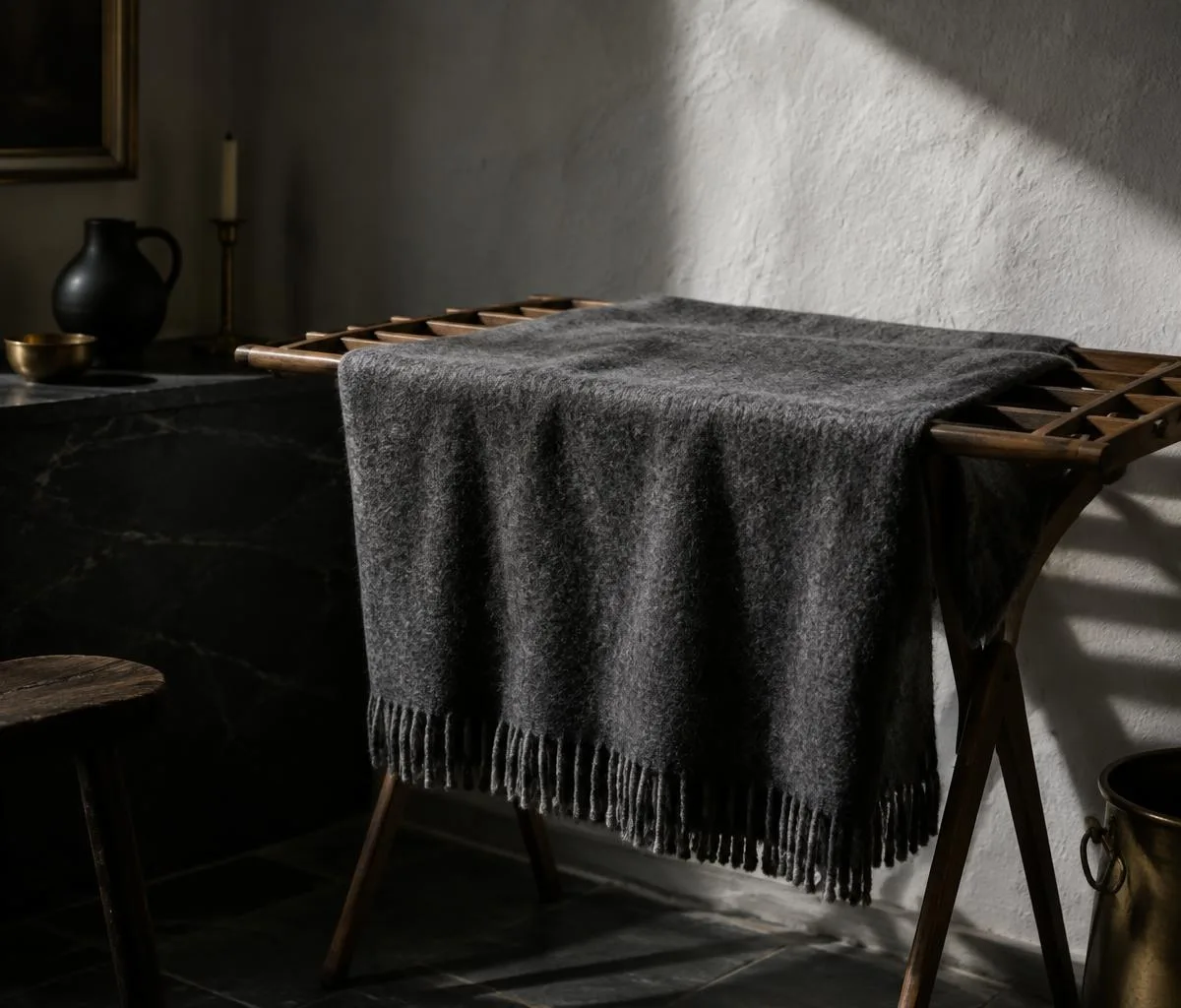
Learn to wash dense wool blankets by hand using low-temperature baths and gentle surfactant soaks. You will preserve the natural loft and crimp of sheep fleece without causing painful felt shrinkage.

- Sudden shifts between hot wash and cold rinse water trigger scale interlocking and felting.
- Static soaking without churning loosens soil while protecting the fiber cuticle.
- Supporting the wet weight of wool prevents stretching during the dry flat phase.
A heavy wool blanket carries the history of its flock and the loom that threw its weft. When we pull a dense twill weave or a soft brushed wool throw over our beds, we rely on the natural crimp of keratin fibers to trap pocket after pocket of still, warm air. Wool repels surface spills naturally because of the trace lanolin remaining on its outer sheath, yet dust, bed oils, and woodsmoke settle deep into the yarns over months of domestic use. Laundering these substantial textiles requires patience, a quiet hand, and an understanding of how raw fleece behaves once submerged.
Most shrinkage in bedding does not stem from cool water alone, but from the union of moisture, thermal shock, and physical movement. When an heirloom blanket enters a home washing machine, the mechanical agitation mimics the traditional fuller's mill, churning delicate yarns into an unyielding, thickened slab of felt. By taking the work into our own hands and relying on simple physics rather than machine agitation, we can wash five-pound camp blankets, point blankets, and fine Merino throws thoroughly while keeping their dimensions, loft, and supple drape intact.
How Wool Cuticles Interlock and Cause Felting
To keep a blanket from shrinking, we look first at the fiber beneath a lens. Each wool hair is built from an inner cortex shielded by overlapping, microscopic shingles called epicuticle scales. Under dry conditions, these scales lie flat and slip past one another smoothly. However, when we submerge wool into warm water, the cuticle softens and its microscopic edges flare outward like pine cones opening in the sun. If fibers in this state are rubbed together, the flared edges catch and hook onto neighboring strands, ratcheting tighter with every pass.
This process is known as felting, and once those scales interlock, no chemical treatment or physical pulling can completely disengage them. The weave contracts, the grid of warp and weft disappears, and the fabric hardens into a dense sheet that has lost its flexibility and warmth. Felting requires three triggers to take place simultaneously: moisture, heat, and friction. If we remove friction entirely from our laundering process, wet wool fibers can rest alongside each other without snagging, allowing the dirt to release into the water without drawing the yarns inward.
The diameter of the wool fiber also dictates how rapidly felting can occur. Finer wools like 18-micron Merino feature more crimp and thinner cuticles, meaning they react faster to slight disturbances than coarse 32-micron wools found in vintage military blankets. The following table illustrates how fiber properties influence shrinkage risk during water immersion:
| Wool Type | Average Fiber Diameter | Cuticle Structure | Felting Susceptibility |
|---|---|---|---|
| Fine Merino | 17 to 21 microns | Prominent, closely spaced scales | Very high; requires strictly passive soaking |
| Medium Down breeds (Suffolk, Dorset) | 24 to 28 microns | Serrated, highly elastic scales | Moderate; resilient against light pressure |
| Coarse or Highland breeds (Scottish Blackface) | 30 to 38 microns | Flatter, widely spaced scales | Low; tolerates slow handling in cool baths |
Selecting Neutral pH Cleansers for Animal Fibers
Standard household laundry detergents are formulated for plant fibers like cotton and synthetic polymers like polyester. They rely on alkaline builders, enzymes, and optical brighteners that hold a pH between 8.5 and 10.5. Animal fibers, consisting of the complex protein keratin, degrade quickly in alkaline baths. High pH strips away the natural lipid layer that keeps wool supple, leaving the core dry, brittle, and prone to breaking during subsequent brushings or washings.
Furthermore, standard detergents often include protease enzymes designed specifically to digest protein stains like blood or grass. Because wool is a protein itself, protease treats the entire blanket as a target, slowly digesting the epicuticle layer and weakening the tensile strength of the yarn. For this reason, we avoid commercial liquid detergents, laundry pods, and powdered soaps completely when handling woolen bedding.
Instead, we seek out neutral pH washes formulated specifically for wool, holding a balanced pH between 6.0 and 7.5. These preparations usually rely on mild vegetable-based surfactants that lift grease without dissolving the fiber core. Some contain a modest measure of cosmetic-grade lanolin, which redeposits onto the washed yarns to replenish the protective fats lost to age and light exposure. If specialized fiber wash is unavailable, a gentle, fragrance-free baby shampoo or a pH-neutral dishwashing liquid used at a minimal dose of one teaspoon per gallon of water serves as an acceptable substitute.
The Static Tub Soak Method for Heavy Blankets
The safest vessel for washing a king, queen, or heavy twin blanket is an ordinary porcelain or enamel bathtub. Before beginning, scrub the tub basin clean of soap scum, bleach residue, and bath oils, as these trace chemicals will discolor damp wool. Fill the tub with enough water to submerge the folded textile completely, usually around fifteen to twenty gallons. The water temperature should feel tepid to a submerged wrist, measuring between 68 and 75 degrees Fahrenheit. Cold water inhibits soap solubility, while hot water softens the cuticles dangerously.
Stir three to four tablespoons of your chosen neutral cleanser into the bath before the wool ever touches the water. Ensuring the cleanser is fully dispersed prevents localized spots of high soap concentration from embedding in the weave. Fold the dry blanket into an accordion-style rectangle that roughly fits the width of the tub. Lowering the folded blanket straight down into the water prevents the yarns from twisting or bunching unevenly under their own wet weight.
Once the blanket is in the water, submerge it gently by pressing straight down with the flat palms of your hands or the clean soles of bare feet. Do not agitate, twist, knead, or slide the folds back and forth across each other. The goal is simple, vertical displacement of air:
- Press down across the entire surface of the blanket until air bubbles stop rising to the surface.
- Walk away and let the blanket sit completely undisturbed for thirty to forty minutes. During this period, the surfactant weakens the electrostatic bond between wool fibers and dust particles.
- If the blanket shows spots of heavier dirt along the binding or perimeter, touch those spots directly by patting them with a dense lather of wool wash on a soft sponge, avoiding circular rubbing.
- After forty minutes, pull the tub drain plug without lifting the blanket. Let all the wash water drain completely away from the wool.
- Refill the tub with water that matches the exact temperature of the wash water to prevent thermal shock, press down gently to flush out soap, and drain once more. Repeat this rinse step only if using a wash that requires rinsing; no-rinse wool cleansers eliminate this stage entirely.
Pressing Water Out Without Wringing or Twisting
A saturated wool blanket holds between three and five times its dry weight in water, turning a six-pound blanket into a thirty-pound wet mass. At this stage, the fibers are swollen, elastic, and extraordinarily vulnerable to permanent mechanical distortion. If we attempt to lift the blanket by its corners, the heavy wet fibers will stretch, resulting in warped, wavy edges that will never lie flat again. Above all, never twist or wring the fabric to force water out; the circular shearing action locks the cuticles together instantly.
Instead, we press the water outward against the solid foundation of the tub floor. With the drain wide open, lean your weight onto your palms, working methodically from one side of the folded blanket to the other. Squeeze the pooled water out through the fibers and straight down the drain pipe. Take time to work through the layers, applying steady, downward pressure without sliding your hands laterally over the wet surface.
After manual pressing, rolling the blanket with dense terry bath towels extracts the remaining saturation safely. Follow this progression to dry the core without stress:
- Slide the damp, folded blanket onto a dry section of the tub ledge or into a clean plastic laundry basket, supporting the entire base from underneath with both arms.
- Lay two large, thick cotton bath towels flat on a clean, water-resistant floor or large utility table, overlapping their long edges slightly.
- Place the folded wool blanket atop the towels, unfolding it only enough to fit the towel footprint.
- Cover the top of the blanket with another layer of dry towels to create a sandwich of wool and terry cloth.
- Roll the layers tightly into a large cylinder, beginning from one narrow end.
- Walk slowly along the top of the rolled cylinder with your knees slightly bent, using your body weight to press the moisture out of the wool and into the cotton towels.
- Unroll the bundle, discard the damp towels, and repeat the process once more using fresh, bone-dry towels until the blanket feels cool and damp rather than saturated.
Horizontal Blocking on Drying Racks
Wet wool must never be hung over a thin clothesline or draped over a door. The narrow line of contact concentrates the mass of the wet textile onto a single band of warp threads, causing deep troughs, stretching the weave out of square, and leaving an indelible ridge. Wool blankets dry most evenly when supported horizontally on slatted drying racks or suspended mesh drying nets, allowing cool room air to circulate around both sides simultaneously.
Before leaving the blanket to dry, we perform a tailoring step called blocking. Lay the damp blanket completely flat across the drying surface. Using a wooden carpenter's rule or measuring tape, measure the dimensions across the width and length, comparing them to the original recorded dimensions of the blanket. Gently pat, press, and nudge the damp fabric back into its original rectangular proportions, squaring the corners at clean ninety-degree angles. Straighten the bound edges or woven fringes with your fingertips so they dry straight without curling.
Airflow dries wool far more effectively than heat. Position the drying racks in a room with steady cross-ventilation, running a small box fan several feet away to circulate ambient air across the surface of the wool. Avoid radiant heaters, direct sunlight, and heat vents; excessive heat dries out the natural core moisture of the keratin, causing the outer fibers to become brittle and dull. Expect a heavy winter blanket to dry over thirty-six to forty-eight hours, flipping the textile over once halfway through the process to ensure the underside receives equal air exposure.
Seasonal Storage with Cedar and Cotton Sheaths
Once dried, wool blankets must be shielded from their two primary domestic adversaries: humidity and clothes moths (*Tineola bisselliella*). Moths do not consume wool for moisture; their larvae eat the keratin protein to sustain their growth. Larvae are drawn specifically to residual human perspiration, skin flakes, and food oils that linger on fibers, which makes storing only thoroughly washed, completely dry blankets your first defense against infestation.
Never seal wool inside airtight plastic storage bins, vacuum compression bags, or vinyl zippered pouches. Wool is a hygroscopic fiber that breathes continuously, absorbing and releasing ambient moisture vapor according to the relative humidity of the room. When sealed inside non-porous plastic, trapped moisture condensation creates an environment for mold and mildew to sprout, which can rot the yarns and cause irreversible discoloration. Instead, wrap clean blankets in washed, unbleached cotton muslin or slip them inside breathable percale cotton pillowcases.
Add aromatic cedar wood blocks, shims, or shavings to your storage chest or shelf. The natural oils inside raw red cedar (*Juniperus virginiana*) emit volatile compounds that deter adult moths from laying eggs, though they will not eradicate an existing larval infestation. Sand the cedar blocks lightly with 120-grit sandpaper every autumn to expose fresh wood and revive the scent. Place the wood blocks alongside the cotton wrappers rather than in direct contact with the bare wool, as raw wood resins can leach into the fabric and leave yellow stains over time.
Common Mistakes to Avoid
We see several recurring oversights that lead to damaged, misshapen blankets. Being mindful of these small points preserves the longevity of your bedding:
- Changing water temperatures between washing and rinsing: introducing cold rinse water to warm fibers shocks the expanded cuticles into an immediate clench, causing instantaneous shrinkage.
- Lifting saturated blankets by their edges or corners: the weight of retained water snaps delicate cross-threads and permanently distorts the woven selvedges.
- Using vinegar as a fabric softener in high concentrations: while a splash of white vinegar can restore an acid pH, using too much without sufficient water volume will degrade natural lanolin over prolonged soaking.
- Storing blankets in damp basements or hot, uninsulated attics: wide fluctuations in ambient temperature cause hidden condensation inside storage bins, breaking down natural fibers.
- Relying on commercial dry cleaning for simple refreshing: harsh perchlorethylene solvents strip away every trace of lanolin, leaving wool scratchy and lifeless. Reserve professional wet-cleaning services for unstable vintage dyes or blankets with structural fraying.
Preserving Your Wool for the Seasons Ahead
A well-woven wool blanket does not demand frequent washing; under normal circumstances, a deep static soak once every two to three seasons is sufficient. In the intervening months, take advantage of dry, overcast winter mornings to hang your blankets outdoors on a porch rail for an hour or two. Cold, moving air naturally deodorizes animal fibers, redistributes retained humidity, and encourages the natural crimp of the wool to spring back into shape without the stress of water immersion.
When you do prepare for a tub wash, approach the task as a quiet, physical ritual of care. Gather your neutral soap, dry towels, and drying racks beforehand so you never leave a saturated blanket waiting in an awkward state. If you are ever uncertain about the dye stability of a colorful vintage blanket, press a damp white cotton cloth against an inconspicuous corner for sixty seconds; if any pigment transfers to the cotton, set the wash basin aside and seek out a professional textile conservator who specializes in historic fibers.
This publication provides educational material care notes: consult a certified dermatologist or public health officer for clinical advice. Disclaimer