 Lavare Journal
Discover how to sanitize porous timber surfaces safely using simple salt, heat, and food-safe mineral oils. You will protect your kitchen boards from warping while halting cross-contamination.

- Coarse salt and hot water draw out moisture and trapped grease without soaking the wood core.
- Submerging butcher blocks in standing water causes split glue lines and structural warp.
- Regular wax and oil applications seal cellular capillaries against food liquid intrusion.
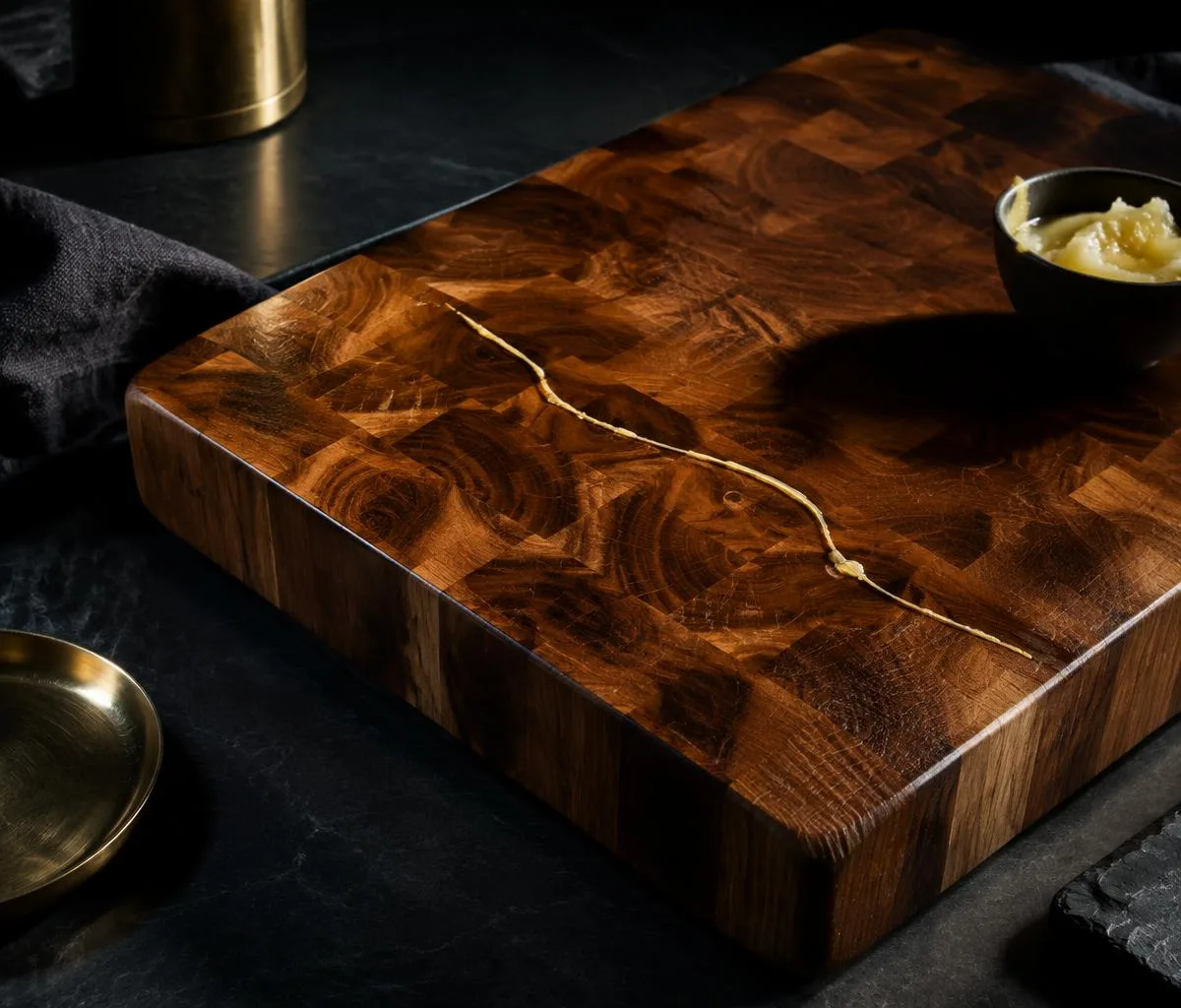
When we assemble an end-grain cutting board in the workshop, we glue dozens of square timber segments together so the growth rings face upward, perpendicular to the knife edge. Looking down at the surface under a raking light reveals the open cross-sections of wood cells, arranged like a dense bundle of hollow straws. This orientation allows knife blades to slip between the vertical fibers rather than severing them, keeping our blades sharp and preventing the deep scars common to edge-grain boards. Yet that same cellular architecture demands a specific rhythm of care. The exposed end grain pulls liquids deep into its interior far faster than long-grain boards do.
Caring for an end-grain block is an exercise in managing moisture and fat. If the wood dries out entirely, ambient humidity fluctuations cause the blocks to shrink and split at the glue lines. If the wood remains waterlogged, the fibers swell, mold takes hold, and the structural bonds fail. Through simple mechanical cleaning, sensible drying, and periodic replenishment with natural waxes and oils, we can preserve the balance of the timber across decades of hard kitchen service.
Capillary Action and Microbial Survival in Wood
Wood is not an inert slab of plastic; it is a porous vascular tissue designed by nature to transport sap and water. In species like hard maple, black walnut, and yellow birch, the open ends of xylem vessels and tracheids sit exposed on the working face. When moisture touches an unsealed board, capillary action draws liquid downward into the lumen of the cells. While this sounds hazardous for food prep, research shows that dry wood fibers naturally inhibit bacterial colonization by pulling available surface water away from microbes, depriving them of the free moisture they require to reproduce.
The interior cells trap small amounts of bacteria and slowly desiccate them over several hours, provided the wood is not kept wet. However, food residues left on top of the board, such as blood, starch, or meat juices, can pool and form a nutrient broth over the open cell mouths. The goal of cleaning is not to sterilize the interior of the wood, which is impossible without destroying the timber, but to strip these organic residues from the top millimeter of fibers while keeping the deeper pores saturated with stable, food-safe lipids.
| Wood Species | Pore Structure | End-Grain Absorption Rate | Hardness Rating (Janka) |
|---|---|---|---|
| Sugar Maple (Acer saccharum) | Diffuse-porous, fine | Moderate and uniform | 1,450 lbf |
| Black Walnut (Juglans nigra) | Semi-ring-porous, medium | Moderate to fast | 1,010 lbf |
| White Oak (Quercus alba) | Ring-porous, tyloses present | Low, pores occluded | 1,360 lbf |
| Red Oak (Quercus rubra) | Ring-porous, open vessels | High, unsuitable for prep | 1,290 lbf |
Scraping and Scrubbing with Coarse Mineral Salt
We avoid harsh detergents on end-grain timber whenever possible, because standard dish soaps break down the cured wax and oil barrier we take time to build. Instead, routine cleaning begins with mechanical scraping. Holding a stainless steel bench scraper at a 45-degree angle, we pull the blade across the surface along the grid lines, lifting away clinging food remnants, fat films, and surface liquids. This simple physical action removes the majority of soil without introducing any extra moisture into the pores.
To deep-clean the timber without washing away the deep oil base, coarse mineral salt serves as our primary abrasive. We scatter two tablespoons of coarse kosher salt or ground sea salt across the damp board. The crystalline structure of salt has hard, sharp edges that dislodge proteins from the cell openings without gouging the wood fibers.
- Scrubbing medium: We take half a fresh lemon, or a stiff tampico fiber brush, and work the salt in small circular paths across every square inch of the surface.
- Osmotic action: As the salt dissolves into the remaining surface moisture, it forms a hypertonic brine that draws additional organic fluids out of the uppermost pores.
- Aroma neutralization: The citric acid in the lemon helps neutralize alkaline odor molecules, such as those left behind by crushed alliums, while breaking down residual surface grease.
Rinsing Under Running Water Without Soaking
After scraping and scrubbing, the loosened grime and spent salt must be cleared away quickly. We hold the board under warm, running tap water, ideally between 30 and 40 degrees Celsius. Hot water softens the protective waxes too quickly, while freezing water fails to lift loose animal fats. Using a clean washcloth or non-scratch sponge, we wipe away the brine completely, spending no more than thirty seconds under the stream.
Soaking an end-grain block in a sink basin is the quickest way to ruin it. When an end-grain board is submerged, water floods the vertical vessels simultaneously from both ends. The wood expands faster than its internal structure can accommodate, stressing the glue lines. Even modern waterproof aliphatic resin glues cannot prevent the wood itself from shearing apart when the cells swell rapidly under hydrostatic pressure.
Every time we rinse the working top of the board, we also rinse the underside. Wetting only one face causes the upper fibers to expand while the bottom fibers remain dry and contracted. This differential expansion produces immediate cupping, lifting the corners off the counter and rocking the board. Equal wetting on both faces maintains balanced internal tension.
Drying on Edge for Uniform Airflow
Once rinsed, the board must be dried with deliberate attention to evaporation rates. We dry the entire exterior with a clean, lint-free cotton towel, pressing firmly into the surface to wick away standing water from the cut ends of the fibers. Towel drying removes the standing liquid, but the wood cells remain cool and damp below the immediate surface.
We place the board on its long edge on a flat, dry counter, or prop it in a slatted wooden dish rack. Standing the board upright allows ambient air to move freely across both working faces at the same velocity. If a freshly washed board is laid flat on a laminate or stone countertop, water evaporates freely from the top face, while the bottom face remains trapped against the counter, staying wet for hours. The top dries, shrinks, and pulls upward, causing the board to bow permanently or crack along the center joints.
- Towel the board thoroughly on all six faces immediately after rinsing.
- Stand the board on edge, avoiding drafty window sills or direct heat registers.
- Allow the board to air-support 8 to 12 hours before moving it into flat storage or applying fresh conditioner.
Applying Warm Mineral Oil and Beeswax Slurry
End-grain boards demand far more conditioning fluid than standard edge-grain planks. To keep moisture out, we must flood the hollow cells with a stable hydrophobic medium. Pure mineral oil penetrates deeply because of its low viscosity, but it tends to migrate out over time. Beeswax, on the other hand, sits on the surface to create a hard, water-repellent seal. We combine them into a warm paste, often called board butter, containing four parts food-grade light mineral oil to one part pure yellow beeswax by weight.
We melt the beeswax slowly in a double boiler over low heat until it reaches roughly 65 degrees Celsius, then stir in the room-temperature mineral oil. Once blended into a warm, creamy liquid, we pour a generous pool onto the dry end-grain surface. The exposed pores pull the warm mixture downward like a lamp wick. Using our bare hands or a cotton rag, we work the slurry over the top, the sides, and the base, feeling the grain drink the mixture until the wood refuses to absorb more.
We leave the board undisturbed overnight, allowing the oil to settle into the wood structure and the wax to cool into a firm, water-resistant matrix near the surface. In the morning, we take a piece of dry unbleached canvas or a stiff horsehair buffing brush and vigorously buff the board in circular strokes. The friction generates mild heat, polishing the remaining surface wax into a satin sheen that sheds droplets of water cleanly during daily prep work.
Sanitizing After Raw Poultry or Fish Preparation
When working with raw poultry, pork, or wet fish, mechanical scrubbing alone may not satisfy your comfort level regarding cross-contamination. Traditional bleach solutions should be avoided on fine cutting boards; sodium hypochlorite breaks down the natural lignin that binds wood cells together, leaving the timber fuzzy, soft, and brittle. Bleach also discolors rich hardwoods like walnut and cherry, leaving pale, washed-out blotches.
For chemical sanitation that respects the timber, we use undiluted three percent hydrogen peroxide or straight five percent distilled white vinegar. Both chemicals provide effective antimicrobial action without degrading the wood structure or releasing toxic compounds into future food preps. We prefer using them as a two-stage spray for thorough surface hygiene:
- First spray: Mist the clean, dry board with five percent distilled white vinegar. Allow it to sit on the timber for five minutes to dissolve mineral scale and create an acidic environment hostile to pathogens.
- Second spray: Mist directly over the vinegar with three percent hydrogen peroxide. The pairing forms peracetic acid in microscopic quantities at the surface, rapidly breaking down bacterial cell walls.
- Wipe and clear: After five minutes of total contact time, rinse the board under lukewarm running water, towel it dry, and set it on edge.
Keep in mind that if you prepare food for commercial purposes or for vulnerable individuals, sanitation guidelines set by local health departments must take precedence over traditional woodworking maintenance routines.
Common Mistakes with End-Grain Timber
We often encounter boards in our shop that have suffered from easily avoidable handling errors. End-grain timber is exceptionally durable under the knife, but it is unforgiving of improper cleaning methods.
- Using the dishwasher: The combination of caustic alkaline detergents, high water pressure, and intense drying cycles will dissolve aliphatic glues, wash out natural lignins, and split an end-grain block into pieces in a single wash cycle.
- Conditioning with vegetable oils: Olive oil, canola oil, sunflower oil, and corn oil contain unsaturated fatty acids that oxidize over time. Within a few weeks inside the pores of the wood, these oils turn rancid, producing a sticky surface and a foul, sour odor that transfers directly into food.
- Washing only one face: Rinsing the working face while leaving the bottom face dry creates unequal moisture content, leading directly to cupping and warped corners.
- Applying oil to damp wood: Spreading mineral oil or wax over a board that has not dried for at least eight hours traps residual moisture inside the cells, encouraging internal mold growth and black fungal spotting beneath the wax seal.
Long-Term Care and Workshop Checkpoints
A well-made end-grain cutting board will give you decades of service if you observe its appearance closely. We check our boards once a week by splashing a few drops of clean water onto the middle of the prep area. If the water forms rounded, high-standing beads on top of the wood, the wax barrier is intact and working properly. If the drops flatten out and darken the wood within thirty seconds, the pores are empty and thirsting for oil.
Set aside an evening once a month to wash the board deeply with salt and lemon, let it dry upright on edge overnight, and flood it with warm oil and wax slurry the following morning. If you ever notice knife grooves that feel rough under your fingertips, or small height differences between adjacent wood blocks due to humidity shifts, set the board aside for light workshop dressing. Flattening the face with a cabinet scraper or an oscillating sander loaded with 150-grit abrasive paper will refresh the fibers and restore a flat, unified cutting surface for years to come.
This publication provides educational material care notes: consult a certified dermatologist or public health officer for clinical advice. Disclaimer